
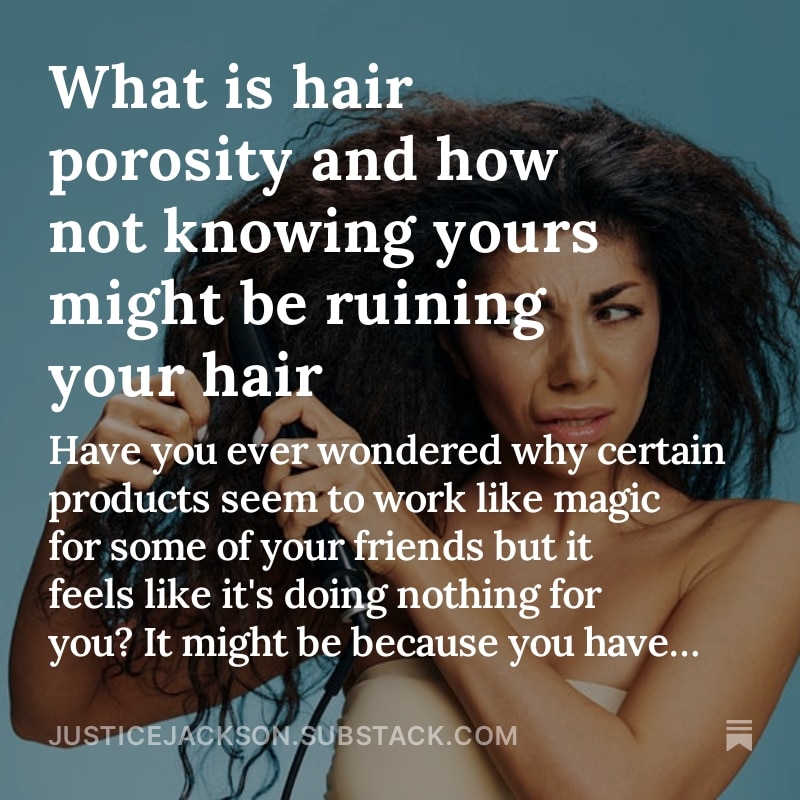

Have you ever wondered why certain products seem to work like magic for some of your friends but it feels like it’s doing nothing for you? It might be because you have different hair porosity’s.
Hair porosity has been a trending phrase in the hair community for a while now, Yet so many of us still have no clue what it even means. Some say it’s arguable if knowing your hair’s porosity is even important, but in my opinion and experience, it’s one of THE most important factors in helping you have a stress-free hair journey.
What is hair porosity?
What even is hair porosity though? Hair porosity is a measurement of your hair’s ability to absorb and retain moisture. The porosity of your hair affects how well products, water, and oils pass in and out of the hair cuticle. You can have low porosity, medium porosity, or high porosity hair (or even a combination of porosities in your hair).
If you have low porosity hair, you may experience it taking a long time to fully soak your hair in the shower/bath. As well as your hair taking an excessively long time to dry when it DOES absorb moisture. It also will seem like products tend to sit on top of your hair instead of immediately soaking in.
On the other hand, you experience the complete opposite with high porosity hair. Your hair mostly soaks up water quickly but it loses moisture just as quickly. Your products soak into your hair fast as well, but your hair doesn’t stay moisturized for very long.
As for medium porosity hair, your hair doesn’t take forever to absorb moisture but it also doesn’t absorb instantly. So it’s literally a happy medium.
FInding out your hair’s porosity is one of the more difficult tasks that you should be figuring out on your hair journey. Some people say to do the water in a cup method which is having a cup of water and putting a strand of your hair in the cup. If it sinks, you have high porosity hair, if it floats you have high porosity, and if it stays in the middle, you have medium porosity. Although,in my opinion, it’s not very accurate. Most people that do the test come to the conclusion that they have low porosity hair. But let’s be real, if you put anything as light as a hair strand in a cup of water, it’s most likely going to float either way.
How to find your hair porosity
What I recommend to accurately find out your hair’s porosity is to first make sure to use a CLARIFYING SHAMPOO, like the One and Only Argan OIL Shampoo, before you do anything. A lot of people are convinced they have low porosity hair when they may just have product build up (which can give the illusion of low porosity hair). Shampoo twice for best results and do not put any conditioner on your hair. Dry your hair and take a small section and put any leave-in conditioner on it ( I recommend the Mielle Pomegranate & Honey Leave-IN) If it seems to soak in fast (within 30 seconds) then you probably have high porosity hair. If it takes longer than a minute to soak in then you probably have low porosity hair. If it takes a moderate amount of time, (between 30 seconds to 1 minute) then you may have medium porosity hair.
I recommend using your own judgment to decide what “fast” or “slow” absorption is for you, but this is a good guideline to decide for yourself.
By the way, your hair’s porosity can change as well. If you have low porosity hair and have used excessive heat then you could become medium to high porosity. Same thing if you bleach, dye, or relax your hair. Your hair porosity typically becomes higher if you do anything that can chemically change your hair or when using too much heat/manipulation.
How does hair porosity change your routine?
So now we know HOW to find your hair’s porosity but how does this affect your hair care routine?
As someone who has been both low porosity and then became high porosity from dying and bleaching, I can safely say that the way you go about each level is a bit different.
Low porosity hair is susceptible to product build up and protein overload quicker than high porosity hair since the hairs cuticle is so closed. For low porosity hair, it is so important to have a good clarifying shampoo and to be sure to deep condition with heat (a plastic cap + hair dryer) to help open up the cuticle and have moisture penetrate easier. You also shouldn’t overdo the heavy oils, like coconut oil, castor oils, etc. I recommend lighter oils like grape seed oil and jojoba oil. Don’t use a protein treatment every wash day either, your hair will feel like straw immediately. It’s also important to avoid products with silicones in them, like dimethicone, so always check your ingredient lists before purchasing a product.
High porosity hair is typically known to be a little bit lower maintenance though. You don’t have to worry as much about protein overload since it’s actually recommended to use more protein for high porosity hair. You should also try to use oils after applying you products since the moisture leaves your hair so quickly. You can still use a clarifying shampoo but not too often since you don’t want to strip your hair. A gentle shampoo every washday and a clarifying shampoo 1x a month should be just fine. Silicones also don’t “hurt” your hair as it would low porosity hair. Your hair may actually benefit from using silicones from time to time, especially when you plan on using heat or bleach on your hair.
As for medium porosity hair, you just have to use everything in moderation. You’re in a great place for your hair journey as you won’t have to do anything specific to make sure your hair feels its best. Don’t overdo the protein treatments, make sure to clarify 1-2x a month, avoid silicone products except when using heat/bleach, and use a light oil to seal your hair for long lasting moisture.
Now, since hopefully you know a little bit more about your hair, it should be easier to figure out what your hair needs are. This isn’t the only factor in making sure your hair is getting its best treatment though. It was the most important for me as I began learning my hair, but for some people this may not matter at all for them on their hair journey. So be sure to use your own discernment.